Every Voice at the Table: How Student Interpreters Support Faculty Board Meetings

Two MA Translation students discuss their experiences interpreting Leiden University Humanities' Faculty Board council meetings.
Since the Tower of Babel, language accessibility has been an important part of everyday life. With more than 7000 languages being spoken in the world today, translation is definitely not out of the picture. Whether it is for trade, doctor appointments, or, in this case, faculty meetings, translation is important for people's voices to be heard and for promoting participation. This is also the case for the Humanities’ faculty meetings. Faculty council meetings are generally held in Dutch, which can discourage people without or with limited knowledge of Dutch to participate in this important decision-making process.
“Since last December, the two of us became involved in the project: translating documents with the help of professional translation tools and providing live interpretation during the council meetings. It was an interesting experience, having to set up a workflow from scratch and communicating between different members of the Faculty Board and Council.”
The challenge
In previous years, non-Dutch speaking members of the council made use of either automated translation tools like Google Translate or the services of ‘language buddies’ - students without training in translation, appointed through an external hiring service. These language buddies provided written summaries of what was discussed during the FB meetings. While this setup had its perks, it did cause a significant delay in conveying the information. This prevented ad hoc communication and meant that non-Dutch speaking members would often feel left out of the ongoing discussions.
The proposal
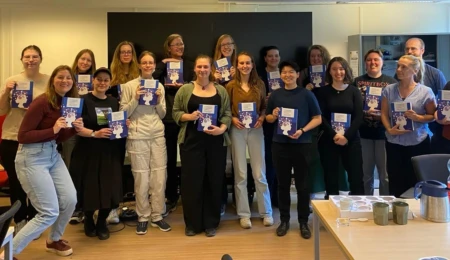
Last year, something changed. For the very first time, trained translation students from the MA Translation stepped in to provide professional translation and live interpreting during board meetings as part of a work placement. Two students, Fleur van Tellingen and Robin de Vries, did a pilot interpreting internship at the Humanities’ Faculty Council. The project on ‘Accessible Faculty Board meetings’ started at the initiative of Prof. dr. Marina Terkourafi, Professor of Sociolinguistics at LUCL and senior member of the Board, in collaboration with Dr. Lettie Dorst, Associate Professor at LUCL, and the internship supervisor Dr. Alina Karakanta, Assistant Professor at LUCL.
The experience
Robin de Vries refects, “Before we started, I did already have experience with transcribing upper-level management meetings, but live interpretation was quite new to me. But I think it went quite well after the initial meeting. The student members we supported were very forgiving if we ever stumbled over some more difficult words, and we collaborated well on some of the issues that arose while translating the (sometimes very) long documents that accompanied the meetings. Hopefully the next pair of interns will continue developing these tools and smoothen the entire process even more!”
Fleur van Tellingen says, “When information about this new internship was shared, I was immediately enthusiastic. I learned a lot about translation in my master's degree, but interpreting was not something I had a lot of experience with. Our internship supervisor, thankfully, taught us the different ways in which interpretation works and gave us space to practice. The members we interpreted for were very kind and patient and we worked well together during these months. This was a new internship, so we discovered a lot of things along the way and there are still things that can be improved, but for now there is a foundation for a more efficient translation process, and I hope that the next pair of interns will expand and develop it even further!”
The verdict
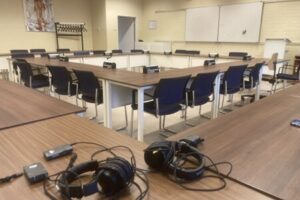
The interpreting program was found useful by the non-Dutch speakers, as it allowed them to follow the discussions and participate more actively in the decision-making and voting process. The programme was also generally well-received by other board members, with many members considering it important to facilitate inclusive and accessible meetings, especially with the increased involvement of international students and staff members in Faculty life.
This internship has shown how small steps in accessibility can make a big difference in academic governance, as it allowed non-Dutch speaking members to participate more actively. And for us, it confirmed what we already believed: language should never be a barrier to participation. After its successful implementation in the first year, the interpreting programme is now continuing with two new student interpreters.