Exploring Language Barriers, Machine Translation, and Health Communication for More Equitable Care

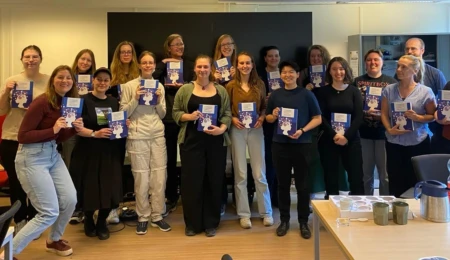
MA Translation student, Noa Warren, shares her thoughts on working as a student research assistant on two research projects at Leiden University Centre for Linguistics.
Imagine you live in a foreign country and suddenly need to go to the hospital. You are anxious, unsure about how the healthcare system works, and not fully confident in the language. Now imagine your doctor hands you a flyer about vaccinating your children, but written in a language you do not fully understand. A hospital visit is stressful for anyone; add a language barrier, and it can quickly become overwhelming. In situations like these, people are asked to make critical health decisions for themselves or their families whilst navigating uncertainty and vulnerability.
Two research projects
As a student in the Leiden MA in Translation with an interest in medical translation, I didn't hesitate to apply for the student research assistant position on two funded projects that address these scenarios. Over the past two years, I have been working both individually and in collaboration with other students under the supervision of Dr Susana Valdez. Our work has focused on two projects related to machine translation in healthcare contexts, written healthcare communication, and equitable healthcare.
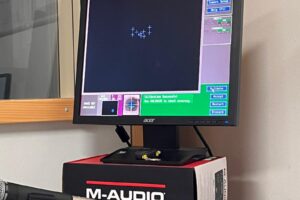
The first project, ReACT, funded by the NWO SSH Open Competition, explores how readers process and interpret vaccination texts from the RIVM, using eye tracking and follow-up interviews. The second project, Health and Migration, funded by a KIEM grant, looks at how healthcare professionals at the LUMC navigate language barriers in doctor-patient communication, particularly in light of the increasing use of AI and machine translation. This is what I want to reflect on in this post.
Designing and conducting interviews, using software…
What I valued most about working as a student research assistant was how involved I was in the research process. I wasn’t just observing from the sidelines, taking on a supportive role. I was actively contributing. This allowed me to develop my skills as an active and more independent researcher. Together with another research assistant, I helped design a survey and follow-up interviews and took part in organising and conducting them independently. Along the way, I learned to think more carefully about research questions and developed practical communication and interviewing skills. I also gained experience working with eye tracking software, as well as working directly with research participants in the lab. Because both projects involved working with human participants, I also became more aware of the ethical responsibilities that come with research, particularly the importance of informed consent.
…data collection,…
I was also closely involved in working with the data we collected. This included organising datasets, working with interview transcripts, and learning how to code qualitative data using Atlas.ti, an entirely new skill for me. With guidance from my supervisor, I gained hands-on experience in qualitative analysis that went beyond anything I had encountered in class.
…and even a publication!
What made my experience as a research assistant truly special was collaborating on an official publication reporting our findings. Being part of the writing and submission process allowed me to put my academic writing skills into practice and to see how research becomes public. From peer review to communication with a journal, this was my first real insight into how academic publishing works and it was one of the most valuable parts of the experience. I was able to go beyond writing papers for my studies, and move towards communicating impactful results to people outside the university in a meaningful way.
It has been extremely insightful to work on topics related to communication and translation in healthcare contexts. I regard this research as truly meaningful and I feel proud to have contributed to it as a student. Taking up this position has not only furthered my interests in research in general, but also in the exploration of these important topics. I very much look forward to further supporting this type of research, and perhaps even finding a future in it after my studies.
References
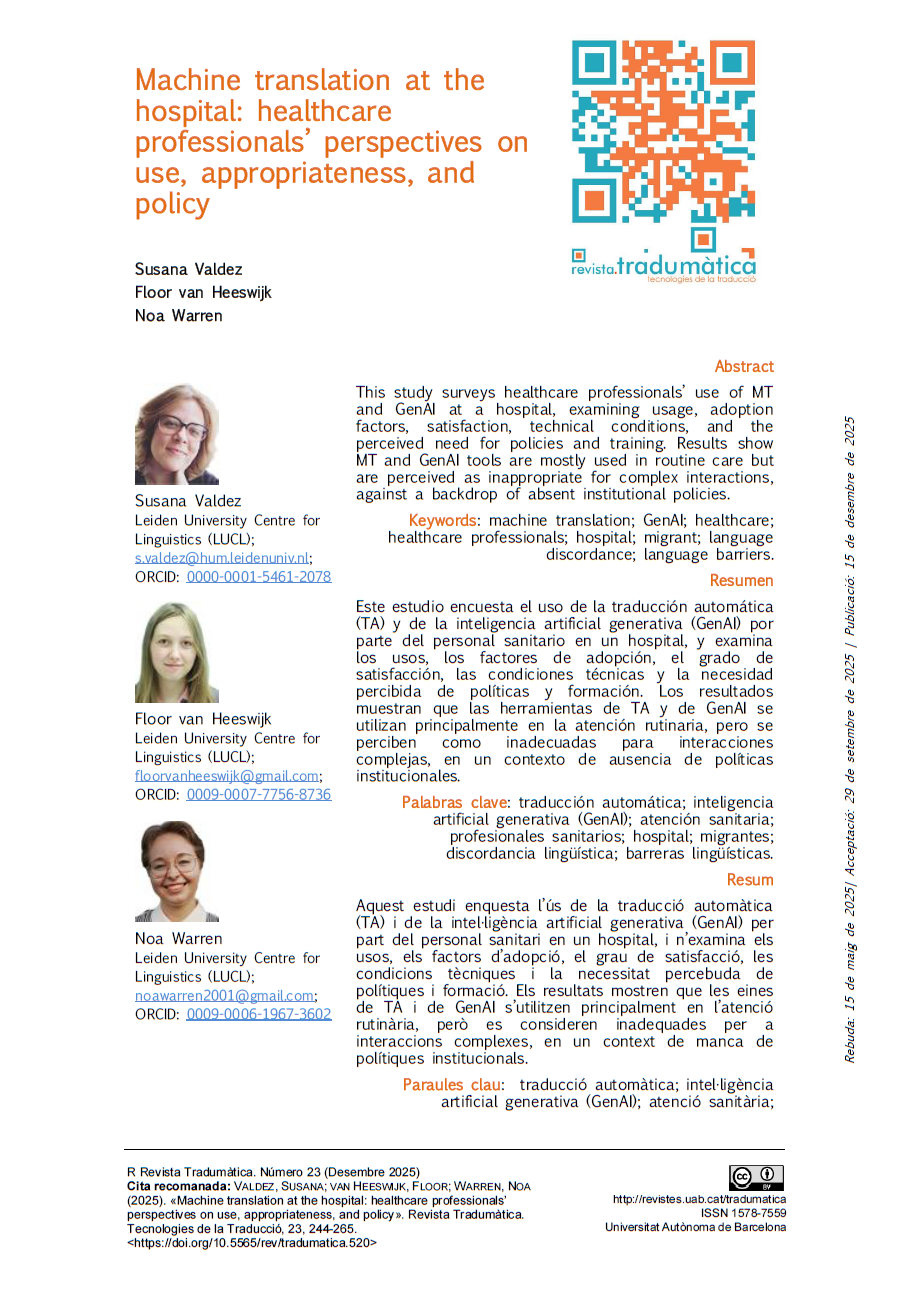
- Valdez, Susana, Floor van Heeswijk, and Noa Warren. 2025. “Machine Translation at the Hospital: Healthcare Professionals’ Perspectives on Use, Appropriateness, and Policy”. Revista Tradumàtica: Translation Technologies 23, 244-65. https://doi.org/10.5565/rev/tr....
Acknowledgement
- This publication has been made possible with the support of the Dutch Research Council (NWO) [grant SSH Open Competition 2024; file no. 406.XS.24.02.113], and Leiden University [grant KIEM-2023-25]